A one-month-old full-term male infant was evaluated in the outpatient department for oral lesions noted since birth. The infant was born to a primigravida mother at 39 weeks of gestation, weighing 3200 g (10th–50th percentile), via vaginal delivery. The birth hospitalization was uneventful, and the infant was discharged on exclusive breastfeeding. Numerous small whitish lesions were present on the outer gingival surface of the maxillary gums [Figure 1]. The lesions appear as small white pearly nodules, approximately 2–5 mm in diameter, with smooth margins. The lesions were present both as solitary nodules and in clusters.

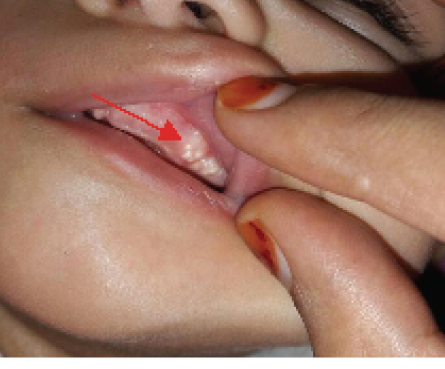 Figure 1: Multiple pearly white nodules over the maxillary alveolar surface in a newborn suggestive of Bohn’s nodules (red arrow).
No mucosal inflammation was present. The rest of the oral cavity was normal. On palpation, the non-indurated lesions were firm, without pain or tenderness. The parents reported good breastfeeding, and the infant was observed to be growing well. Over time, the lesions regressed in size. The infant’s lesion resolved by four months of age, leaving no residua. The systemic examination of the infant was within normal limits. Informed consent was obtained from the patient’s mother.
Question
1. What is the most likely diagnosis?
a. Epstein’s pearls.
b. Ranula.
c. Prenatal teeth.
d. Bohn’s nodules.
e. Dental lamina cysts.
Answer
d. Bohn’s nodules.
Discussion
These nodules are diagnosed as Bohn’s nodules based on their characteristic visual appearance and site of presentation.1,2 Bohn’s nodules are benign keratin-filled inclusion cysts found in the oral cavity of newborns.3 They typically occur on the outer gingival surfaces, more commonly on the maxillary than the mandibular area. Other inclusion cysts include Epstein’s pearls (located on the hard palate) and dental lamina cysts (at tooth eruption sites, alveolar edges).

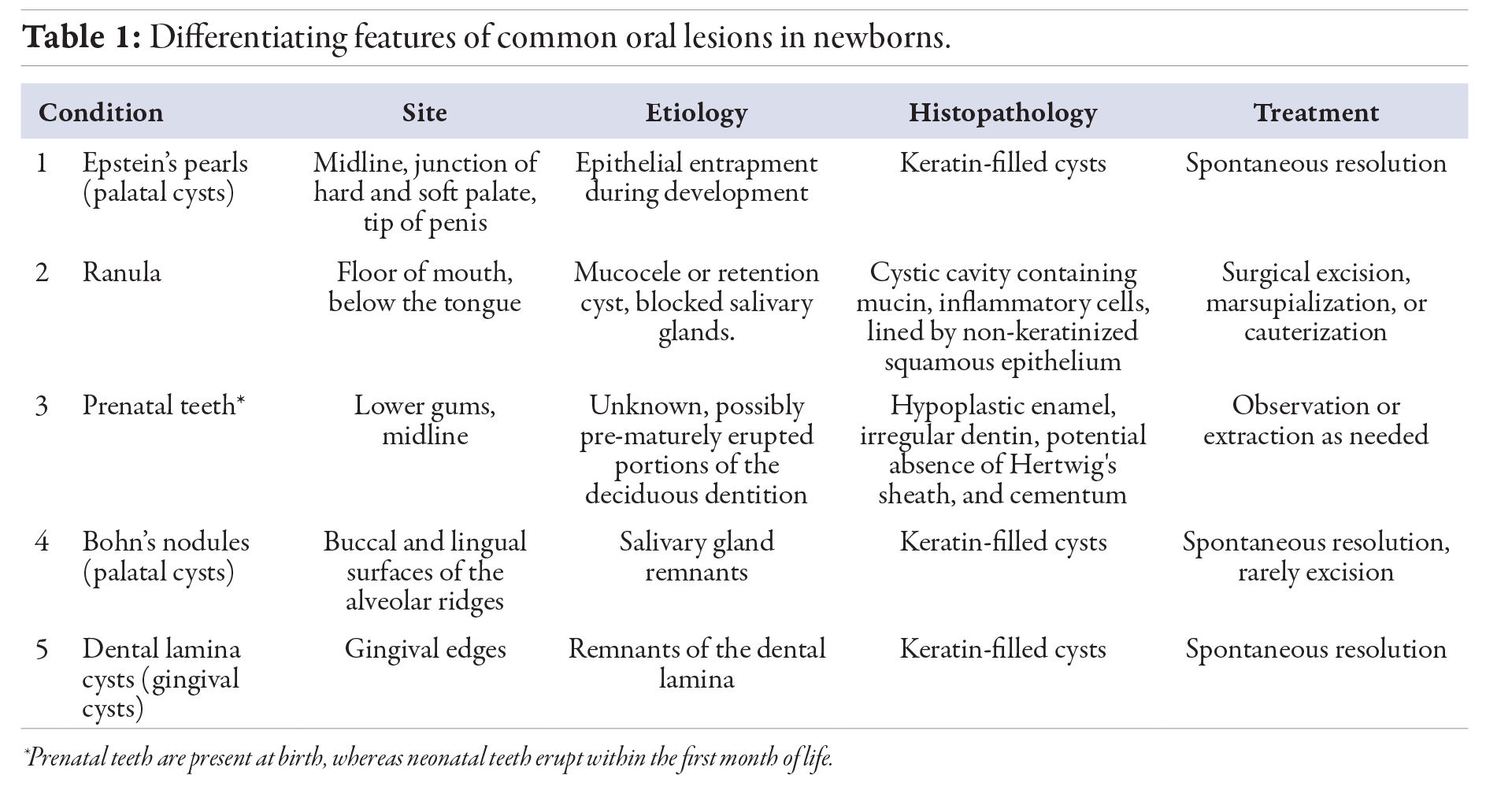 Table 1
Bohn’s nodules are often confused with pustular lesions of the gums. However, careful examination reveals their keratin-filled nature, imparting a characteristic pearly appearance. They can be distinguished from common oral conditions such as natal teeth, congenital epulis, or ranula [Table 1].⁴ Bohn’s nodules regress within a few months of age and rarely require surgical excision. No treatment is necessary, and reassurance to parents is important.
Disclosure
The authors declare no conflicts of interest.
references
- 1. Gupta N, Ramji S. Bohn’s nodules: an under-recognised entity. Arch Dis Child Fetal Neonatal Ed 2013 Sep;98(5):F464.
- 2. Valerio E, Cutrone M, Chiandetti L, Trevisanuto D. Exuberant upper gum lesions in a neonate. J Pediatr 2013 Nov;163(5):1521.e1.
- 3. Perez-Aguirre B, Soto-Barreras U, Loyola-Rodriguez JP, Reyes-Macias JF, Santos-Diaz MA, Loyola-Leyva A, et al. Oral findings and its association with prenatal and perinatal factors in newborns. Korean J Pediatr 2018 Sep;61(9):279-284.
- 4. Cizmeci MN, Kanburoglu MK, Kara S, Tatli MM. Bohn’s nodules: peculiar neonatal intraoral lesions mistaken for natal teeth. Eur J Pediatr 2014 Mar;173(3):403.